
Pakistan football rarely moves in straight lines. This week in Bangkok proved that again. In the space of three days, Pakistan’s futsal teams experienced something the country’s football culture knows too well: historic firsts arriving hand-in-hand with heavy defeats, followed quickly by moments of real resistance.
From the women’s national team playing their first-ever international futsal match, to the men’s side suffering a brutal opening loss before finally breaking their international duck, the 2026 SAFF Futsal Championship has already offered a compressed version of Pakistan football’s wider story. Fragile foundations, visible gaps, but also signs of belief beginning to take root.
This was not just a week of results. It was a week of evidence.
The Women Open a New Chapter
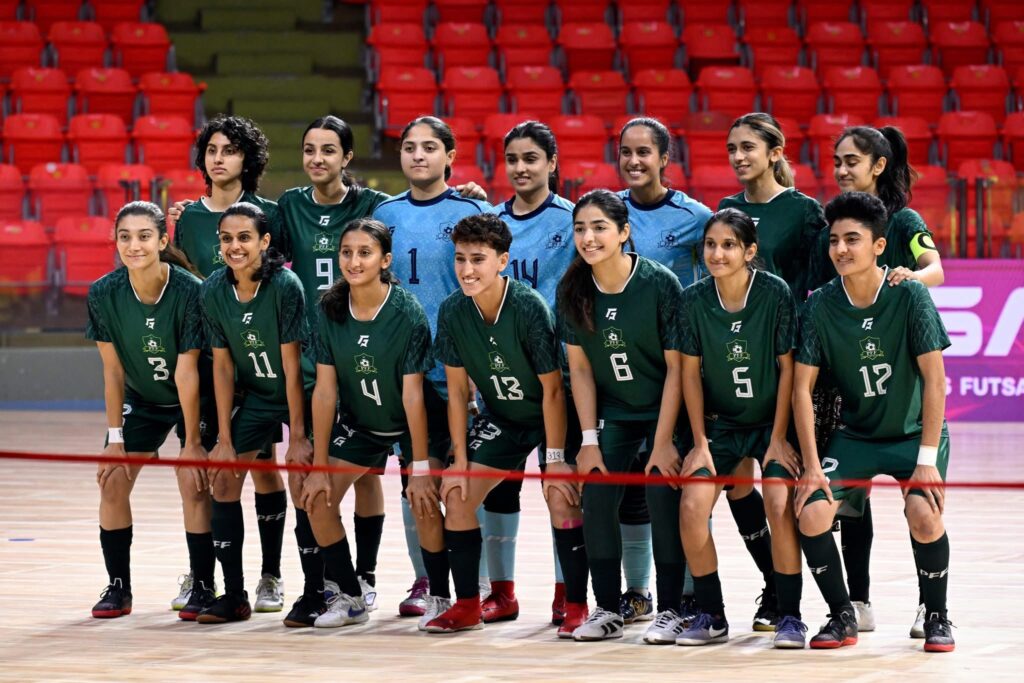
When Pakistan walked out against Bhutan on 13 January, the scoreline almost felt secondary. This was the country’s first-ever women’s international futsal match. A new badge on a new stage, played by a squad blending domestic players with diaspora-based footballers, many of whom were meeting competitive futsal at this level for the first time.
The opening exchanges showed exactly that. Bhutan controlled more of the ball, while Pakistan sat compact and looked to counter. There was nervous energy, rushed decisions, and moments where the speed of the five-a-side game caught Pakistan out. But there was also structure, discipline, and a clear willingness to absorb pressure.
The breakthrough came through the captain. Kayanat Bokhari, based in the Netherlands, took responsibility in the 23rd minute, finding space and beating Sangita Monger to give Pakistan a historic first futsal goal.
The lead did not last long. Yeshey Bidha’s strike from outside the box brought Bhutan level, a reminder of the technical edge Pakistan still need to bridge. From there, the match opened up. Both sides pushed. Both had chances. Jennah Farooki was forced into several strong saves as Bhutan searched for a winner.
When the final whistle went at 1-1, it felt like more than a draw. It was Pakistan women stepping into a new discipline and proving they belonged on the court. No hiding. No collapse. A foundation laid under real pressure.
A Brutal Reality Check for the Men
If the women’s opener was about beginnings, the men’s first match was about exposure. Against Maldives on 14 January, Pakistan were dismantled. Five goals conceded in the first period alone told its own story. Relentless Maldivian movement, sharper rotations, and a clear understanding of futsal spacing ripped through a Pakistan defence that struggled to adjust.
By halftime it was 5-0. By full-time, 7-1. Ahmed Hameed, Ali Shiyah, Mohamed Imran, Zaidhaan Ahmed, and Ali Shamal Abdulla all found space far too easily. Imran added a second after the break, Abdulla Shafiu followed, and Pakistan’s only reply came through Nisar Hussain, a consolation that did little to mask the gulf.
This was not just a bad day. It was a structural reminder. Pakistan entered this tournament carrying scars from last year’s AFC Futsal Asian Cup qualifiers in Saudi Arabia, where repeated defeats exposed the absence of a domestic futsal ecosystem. Maldives, by contrast, played like a side that lives this format. The difference was not only fitness or flair. It was familiarity. For Pakistan, the court still looks foreign.
Twenty-Four Hours That Changed the Tone
The most important response to a heavy defeat is not what is said afterwards, but what follows next. Less than 24 hours after the Maldives loss, Pakistan’s men returned to the court against Bhutan. This time, the women’s team were in the stands. This time, the body language was different. This time, Pakistan were tested and did not fold.
They still went behind. Dawa Tshering struck twice in the first period, and at 2-0 down, the same script seemed to be loading again. Instead, Pakistan finally rewrote it.
Captain Muhammad Hassaan Zafar Khan pulled one back in the 28th minute, injecting belief into a side that suddenly pressed higher and moved the ball quicker. The equaliser followed soon after, Asif Ahmad Chaudhry smashing past Tashi Norbu to level the match.
Then came the decisive burst. Muhammad Adan Ashfaq struck twice in quick succession, turning a deficit into a 4-2 lead within minutes. For the first time in international futsal, Pakistan were not chasing history. They were protecting it.
The closing stages were not pretty. Bhutan pushed. Pakistan defended deeper. Muhammad Tahir was called into action. But this time, Pakistan held. At the final whistle, it was confirmed. Pakistan’s first-ever men’s international futsal victory. No ceremony. No slogans. Just players on the court, finally allowed to exhale.
What This Week Really Told Us
Taken in isolation, a draw, a heavy defeat, and a comeback win do not define a program. Together, they reveal it. Pakistan’s futsal teams are starting from zero. There is no deep domestic league feeding these squads. There is no generational pipeline of futsal specialists. What exists is adaptation. Footballers learning a faster, harsher, more technical version of their game under international conditions. The women showed composure and defensive discipline in their first step. The men showed exactly how far behind Pakistan are when facing sides who have invested in the format. They also showed something equally important: that even within limited preparation, resilience can still be built.
That Bhutan comeback did not arrive through luck. It came from increased pressure, quicker ball circulation, and leadership on the court. Those are coachable elements. They are also rare in Pakistan’s international performances. This week in Bangkok did not solve Pakistan futsal. It did something more valuable. It defined where the floor is, and hinted at where the ceiling might begin.
A Win and Road Ahead
The tournament continues, and tougher tests are coming. The women faced Maldives today and defeated the opponents 3-1, Goals from Anmol, Kaya & Azwa seal a brilliant win at the SAFF Women’s Futsal Championship While the men’s schedule remains unforgiving in a competition where every team plays six matches. Results will fluctuate. Heavy nights are almost guaranteed. But Pakistan now carry something they did not bring into Thailand.
A goal in their first women’s futsal match. A point in their first women’s futsal match. A win in their first men’s futsal campaign. A win in women’s futsal match.
In Pakistan football, progress rarely announces itself loudly. Sometimes it appears as a saved shot. Sometimes as a late equaliser. Sometimes as a group of players, exhausted, defending a two-goal lead they have never held before. This week was not about medals. It was about beginnings that finally looked real.
About the author: Mohsin Rasheed is the Co-founder & Chief editor of Footballer.pk