
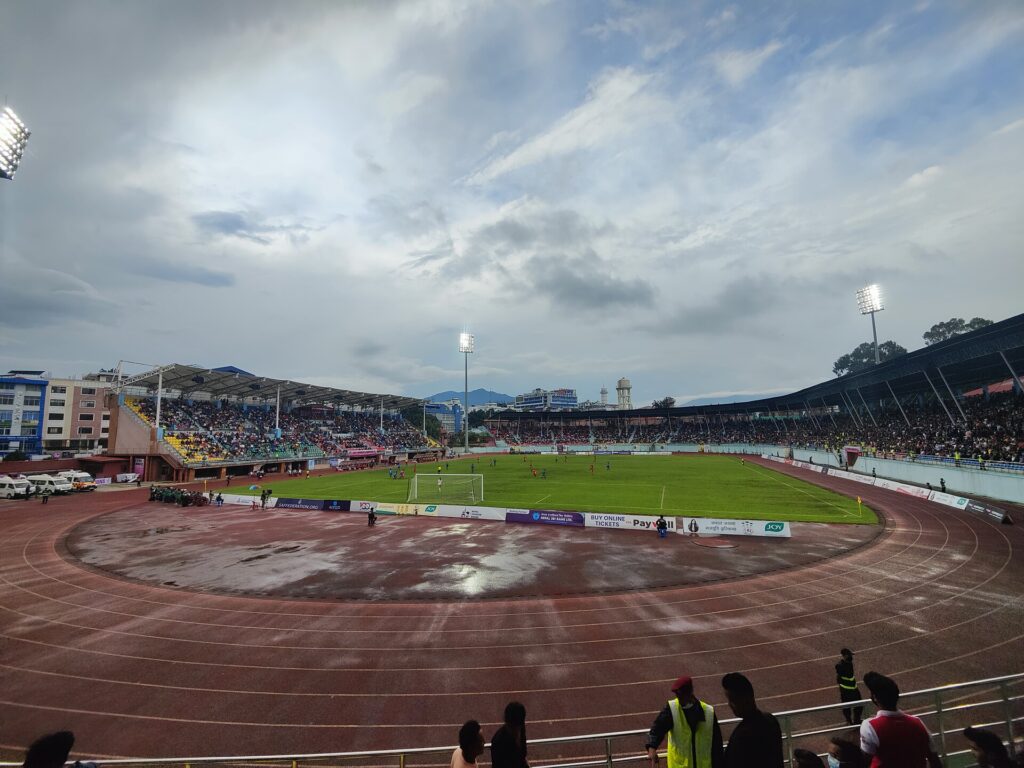
Kathmandu, September 2022. Pakistan are three goals up on Maldives by half-time and don’t let up. It ends 7–0, and Nadia Khan scores four herself.
Three days earlier, the same group opened against India, ranked 58th at the time, and lost 3–0. Between those bookends sat the thing that matters: a national team back on a calendar, playing three matches in a week, and proving there was still a core to build around.
A week that restarted a program
Pakistan’s women returned to tournament football at the 2022 SAFF Women’s Championship. The opener against 58th-ranked India finished 3–0 to India. Nepal then won 6–0. In the last group game, Pakistan put seven past Maldives, the day Nadia Khan scored four.
The contrasts were blunt and instructive: a side learning to survive against a regional heavyweight and, in the same week, showing it had pace and finishing when the game tilted its way. Those 270 minutes are the cleanest line you can draw from a lost decade to a functioning international side.
The selection that made it possible
The restart began off the field. FIFA lifted the Pakistan Football Federation’s suspension on 30 June 2022 after 14 months, and Pakistan’s SAFF entry was confirmed on 9 July. A 35‑player camp opened in Lahore in August under new head coach Adeel Rizki; a 23‑player squad followed on 24 August.
Seven players in that list had been part of the team that last played in 2014. Two overseas players, Nadia Khan and Maria Khan, were included for the first time. The armband moved to Maria Khan from Hajra Khan, with Malika‑e‑Noor named vice‑captain. That spine — veterans plus first‑time call‑ups — is the through-line from 2014 to now.
Before the gap: getting on the board (2010–2011)
The women’s national team was formed in 2010 and made its debut on 31 January that year against India at Dhaka’s Bangabandhu National Stadium. At the same South Asian Games, Pakistan finished fourth of five. In November 2010, Tariq Lutfi took over as head coach.
The inaugural SAFF Women’s Championship that December set early reference points: wins over Maldives (2–1) and Afghanistan (3–0), and heavy defeats to Nepal (0–12) and India (0–8 in the semi-final). Those official matches put Pakistan on the FIFA Women’s World Rankings for the first time on 18 March 2011 — 121st in the world, 22nd in Asia. In May 2011, four squad members travelled to the United States for a two‑week FIFA Women’s World Cup Developing Program.
Two more cycles, then nothing: 2012 and 2014
In September 2012 at the SAFF Women’s Championship in Colombo, the results dipped: losses to Nepal (0–8) and Afghanistan (0–4) before a 3–0 win over Maldives. Two years later Pakistan played three friendlies away to Bahrain in October 2014.
A month after those friendlies, Pakistan hosted the 2014 SAFF Women’s Championship in Islamabad. The hosts lost to Sri Lanka (1–2) and Nepal (0–2), and beat Bhutan 4–1 — the first time Pakistan scored four in a match. Seven of the players from that 2014 group would be named again eight years later.
Relearning the calendar: 2023’s mileage
January 2023 in Saudi Arabia brought a small but useful set: a 1–0 win over Comoros, a 2–1 loss to Mauritius, then a 1–1 draw with the hosts. Four points in three games were enough for runners‑up at the tournament. In April came Round 1 of AFC Olympic qualifying: losses to Philippines (4–0) and Hong Kong (2–0), before a 1–0 win over hosts Tajikistan.
In July, visa delays cut a planned two‑match series in Singapore to a single game, which Singapore won 1–0. In September, Pakistan drew 0–0 with Malaysia and lost 1–0 to Saudi Arabia at a six‑team tournament back in Saudi Arabia. It was an ordinary schedule by global standards, but it was a schedule — and the team took points and learned how to close a result.
| Date/Competition | Opponent and result |
|---|---|
| Sep 2022 – SAFF | India 0–3 L |
| Sep 2022 – SAFF | Nepal 0–6 L |
| Sep 2022 – SAFF | Maldives 7–0 W |
| Jan 2023 – Saudi Arabia tournament | Comoros 1–0 W |
| Jan 2023 – Saudi Arabia tournament | Saudi Arabia 1–1 D |
| Apr 2023 – AFC Olympic Q1 | Philippines 0–4 L |
| Apr 2023 – AFC Olympic Q1 | Tajikistan 1–0 W |
| Jul 2023 – Friendly (Singapore) | Singapore 0–1 L |
The deeper cut
Camp math in 2022: who, how many, and why it mattered
The numbers in the restart were not incidental. After FIFA lifted the suspension on 30 June 2022, the PFF confirmed SAFF entry on 9 July. That compressed window left a head coach — Adeel Rizki — with weeks, not months, to see players and build a squad. The choices read like a risk‑spread: a 35‑player camp in Lahore to cast the net wide; a 23‑player squad to take to Kathmandu trimmed to those who could give minutes immediately; seven veterans from 2014 to anchor habits in a matchweek; and two first‑time overseas call‑ups to change the ceiling. The captaincy shift to Maria Khan, with Malika‑e‑Noor as vice‑captain, formalised that blend.
For a side that had not been on a tournament clock in years, this was as much about bench composition as about a starting XI. Three group games in a week demand rotational cover in the same positions and an exit plan when legs go. The late‑week 7–0 against Maldives — after 0–3 vs India and 0–6 vs Nepal — is exactly the kind of third‑game bounce you get when the depth choices are right. It is also what enabled January–April 2023: five matches in Saudi Arabia and Olympic qualifying decided by one goal either way, with the group taking four points and a clean sheet against Malaysia later that year.
What we don’t have in the public record here
The record used here fixes some things cleanly — five SAFF Women’s Championship appearances, the exact results in 2010, 2012 and 2014, and the 2022–2023 fixture list and outcomes — but leaves others at count level. It does not break down which specific SAFF editions make up the total of five, or give squad-by-squad continuity for the 2010s beyond the named groups above. Where a scorer or minute‑by‑minute context is missing, it is because the public match summaries referenced do not carry it.
What today’s results sit on
The basics are now in place. Pakistan have competed in five SAFF Women’s Championships and remain a team without a major finals appearance: no AFC Women’s Asian Cup yet, no FIFA Women’s World Cup. The post‑2022 ledger already has two wins that matter for confidence — Maldives 7–0 and Tajikistan 1–0 — plus a win over Comoros and draws with Saudi Arabia and Malaysia that tell you game management is improving.
There is also a line running underneath: the under‑19s and under‑16s entered AFC qualifiers in 2019, returning age‑group football to the calendar. That matters when a senior squad can be rebuilt in a month and still travel with seven veterans, two first‑time overseas players, and a new captain. Formed in 2010, back on the board in 2011 at 121st in the world and 22nd in Asia, and, since 2022, steadily learning to win again — that is the arc. The next step is obvious on paper and harder in practice: turn those controlled one‑goal games into qualifying campaigns that end with a ticket.
Sources: Pakistan women’s national football team (en.wikipedia.org); National Women’s Football Championship (Pakistan) (en.wikipedia.org)
Images: Cover: Aarogya1234 / Wikimedia Commons (CC BY-SA 4.0); Figure 1: CAPTAIN RAJU / Wikimedia Commons (CC BY-SA 4.0)
Editorial Note: This article was researched and drafted with the assistance of AI tools, then rigorously fact-checked, proofread, and edited by Mohsin Rasheed, Chief Editor of footballer.pk.

Mohsin is a Founder & Chief Editor of footballer.pk