
On 17 October 2023, the floodlights stayed on long after the whistle. Islamabad’s Jinnah Sports Stadium had just staged Pakistan’s first home international in eleven years and its first World Cup qualifying win, a 1-0 over Cambodia. For the next round, the venue upgraded its floodlights and seats again. One ground, repeatedly patched and prepared, carried the flag at home.
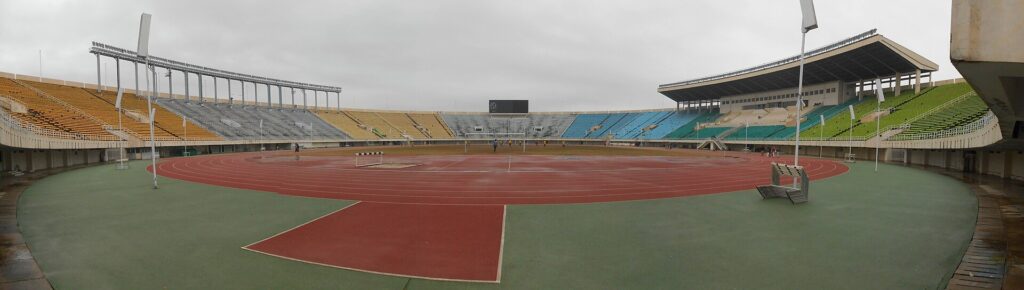
Jinnah is a multi-purpose stadium that today is mostly a football ground and the national team’s declared home venue. It belongs to the Pakistan Sports Board, not the federation, seats 48,700, and by capacity it is the largest stadium in the country. That set of facts has made it both a solution and a crutch.
A stadium built for a Games that moved
The story starts away from football. Jinnah Sports Stadium was built in the 1970s by the China State Construction Engineering Corporation to host the 1978 Asian Games. The event shifted to Bangkok; the concrete stayed in Islamabad. A first major refurbishment came for the South Asian Games in 1989, a reminder that, on paper, this has always been a general-purpose arena.
Football inherited that legacy. In 1986 the ground staged the Quaid-e-Azam International Tournament. Three years later it doubled as venue for the South Asian Games and Pakistan’s first-ever FIFA World Cup qualification campaign for the 1990 tournament. When Pakistan again hosted the South Asian Games in 2004, Jinnah was on the list. In 2014, it hosted the SAFF Women’s Championship.
Football keeps coming back to Jinnah
When Pakistan’s senior men returned to the calendar after years of federation turmoil, the country returned to the same address. On 17 October 2023, Jinnah staged the 2026 World Cup qualifier against Cambodia and Pakistan’s first-ever win in that competition. That night took eleven years to arrive; it took one familiar venue to make it possible.
| Year | Event |
|---|---|
| 1986 | Quaid-e-Azam International Tournament |
| 1989 | South Asian Games (football) |
| 1989 | 1990 FIFA World Cup qualification (Pakistan’s first participation) |
| 2004 | South Asian Games (football) |
| 2014 | SAFF Women’s Championship |
| 2023 | 2026 FIFA World Cup qualification (vs Cambodia), first WCQ win |
The building has never been only football, which is part of why it endures. It hosted the National Games in 2013, with around 2000 athletes across 29 sports and a Jinnah Stadium opening ceremony inaugurated by the Speaker of the National Assembly. Pakistan Army left with the overall trophy that week. Multi-sport kept the venue funded and used; football kept finding it when an international date came up.
Where else? Lahore has a football ground
There is a football stadium in Lahore: Punjab Stadium. That fact sits alongside something the calendar already implies—when a high-stakes men’s international needs staging, Islamabad is the default. Partly that is simple: the national team’s home venue is declared to be Jinnah Sports Stadium.
Below the national side, the domestic game has its own calendar. The Pakistan Premier League is the top domestic league, recognised by the AFC, and the National Challenge Cup runs as a knock-out among departmental and government institutions. The Pakistan Football Federation runs the sport. Those structures are about competitions and squads; the decisive venue for the national team sits outside them, under the Pakistan Sports Board’s ownership.
Money for leagues, not concrete
The one period that surfaces hard money in the public record is the early 1990s, and it is about competitions, not bricks. Under Hafiz Salman Butt, the federation ran the 1992–93 and 1993–94 National Football Championship on a league-style basis, with a B-Division whose winners included Crescent Textile Mills (1992), National Bank (1993) and Frontier Scouts (1994). Butt secured a three‑year Lifebuoy Soap sponsorship worth 35 million PKR for organising the seasons, with televising across the country.
Then came the break. Butt’s dismissal in 1994 and FIFA’s ban in 1995 are part of the familiar institutional story: mismanagement and a long sponsor drought. Through that arc, the ground most associated with Pakistani football remained the same multi-sport bowl in Islamabad. The ledger that exists describes who played and who paid for league seasons; it is largely silent on who paid for concrete, seats and lights.
What we don’t know about the pitches
The record here names venues, dates and competition outcomes at Jinnah Sports Stadium. It does not settle two questions that matter to the present: how many grounds in Pakistan meet modern competition standards, and what the capital and operating budgets look like for the upgrades that have kept Jinnah staging internationals. The refurbishment for the next round after October 2023 is noted in terms of works—floodlights and seats—but not in rupees.
That gap matters because it is the difference between a calendar and a plan. Islamabad’s stadium keeps passing the threshold for major fixtures; Lahore has a football ground; beyond that, the public paper trail does not offer a national list of compliant pitches or a price tag for bringing more of them online.
Ownership and upgrades at a national venue
Two institutions frame every home international: the Pakistan Sports Board (PSB) owns Jinnah Sports Stadium; the Pakistan Football Federation (PFF) runs football. The venue is explicitly the national team’s home ground. When Pakistan hosted Cambodia on 17 October 2023 and advanced to a next round, the stadium then “upgraded the floodlights and seats” for the subsequent matches. That sequence—host, qualify, upgrade—is a tidy illustration of how capital works follow event demand at a state-owned facility. In governance terms, ownership and tenancy are split: PSB holds the asset; PFF is the sport’s operator. That separation shapes everything from access windows to what an “event overlay” can include. Broadcast-lux targets, bowl seating condition, and ingress/egress segregation are football requirements, but the works to meet them sit on a building that also opens for multi-sport weeks like the 2013 National Games. The upside is scale and availability when the calendar calls; the downside is that football cannot unilaterally harden the venue to a single-sport spec. The archival trail records the outcomes—renovated in 1989 for the South Asian Games; upgrades after October 2023—without the procurement mechanics or budget lines that would turn those moments into a programme.
The long memory: results and a recurring address
Pakistan’s footballing memory has match dates and scores long before it had a fixed idea of home. In 1950 the national team played its first internationals in Iran and Iraq. The 1960s produced a 7–0 over Thailand, a 3–1 over Japan, and a runner-up finish at the 1962 Merdeka after a 1–2 loss to Singapore. Touring sides came too—Dallas Tornado spent a week in Pakistan across October–November 1967.
When World Cup qualifying first arrived on Pakistani soil in 1989, the venue was Jinnah Sports Stadium. When the first World Cup qualifying win finally came, it was at the same place in 2023. Between those markers, departmental power shifted—Pakistan International Airlines’ ninth and last national championship came in 1997—but the address for the biggest nights at home did not.
The present tense of an old solution
Jinnah Stadium’s strengths are fixed. It is large, centrally located, and already designated as the national team’s home. It is also a national multi-sport stage under the Pakistan Sports Board, which is why a football date can be slotted into a calendar that once opened the National Games with the Speaker of the National Assembly on the rostrum and sent around 2000 athletes into competition.
What has moved, slowly and fitfully, are the fittings—first renovated in 1989; lights and seats upgraded again after October 2023. Until a fuller public map of compliant pitches exists, this is what home looks like: a familiar bowl in Islamabad, readied again when the calendar says it has to be.
Sources: Jinnah Stadium, Islamabad (en.wikipedia.org); Punjab Stadium (en.wikipedia.org); Football in Pakistan (en.wikipedia.org)
Images: Cover: footballer.pk (AI illustration); Figure 1: Zainii7 / Wikimedia Commons (CC BY-SA 3.0)
Editorial Note: This article was researched and drafted with the assistance of AI tools, then rigorously fact-checked, proofread, and edited by Mohsin Rasheed, Chief Editor of footballer.pk.

Mohsin is a Founder & Chief Editor of footballer.pk