
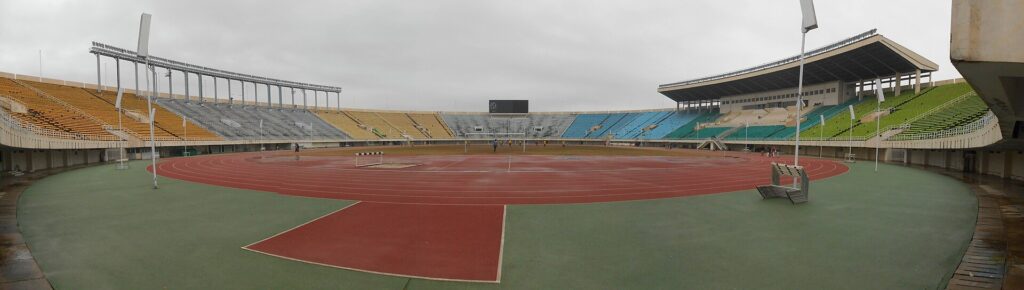
On 17 October 2023, the grass at Jinnah Sports Stadium was new and the goalposts were new. Pakistan hosted a World Cup qualifier in Islamabad for the first time in 11 years, and beat Cambodia — the men’s first-ever win in a World Cup qualifying match — on a surface that had been relaid and refitted to get the date over the line.
Nothing about that night was accidental. The stadium had been pulled back into football shape in the weeks before, then pushed further again for the next round as the fixtures kept coming. The story of those patches of work is the story of Pakistan’s home calendar: what exists, what can be made to exist in time, and the gap that keeps sending fixtures away until there is one ground ready to say yes.
A national team on a ground it does not own
Jinnah Sports Stadium is a multi-purpose venue inside the Pakistan Sports Complex in Islamabad. It is the home venue for the Pakistan national football team and, at 48,700 capacity, the largest stadium in the country. It is owned by the Pakistan Sports Board, part of a campus that also houses Liaquat Gymnasium.
That fact — the national team’s ground belonging to the PSB rather than the federation — has always shaped how home football is staged. Football in Pakistan is run by the Pakistan Football Federation, but the home nights that matter are arranged in a building the PFF does not control day-to-day. Islamabad’s bowl is where the national team plays because it can: it has been a regular home since the 1980s, and the same campus has taken on national multi-sport events when asked.
What exists, concretely
Jinnah was built in the 1970s by China State Construction Engineering Corporation for a Games that never happened — the 1978 Asian Games shifted to Bangkok — and then retooled for what did. It hosted football at the Quaid-e-Azam International Tournament in 1986, was first renovated for the South Asian Games in 1989 with help from Chinese engineers, and again selected when the South Asian Games came back in 2004.
It has seen most of what Pakistan has managed to host in the modern era: Pakistan participated in 1990 FIFA World Cup qualification there; the 2014 SAFF Women’s Championship was staged there; and in 2023 it took the men’s World Cup qualifiers. Elsewhere, there is a football stadium in Lahore — Punjab Stadium — but Islamabad’s bowl is the place that keeps turning international lights on.
The work before the whistle
Ahead of that October 2023 qualifier, the stadium was refurbished — including the grass and the goalposts — to get a playable field and compliant equipment back in place after years of drift. Then, with a second-round calendar to meet, more followed: floodlights were upgraded, and seating was improved.
This is how Pakistan has made home nights possible in the last four decades. A fixture locks in, standards are specified, and the list is worked through until a multi-use national stadium is a football ground again. When the requirement steps up — another phase, another match — the next items are ticked: this time lights and seats, the time before that a full renovation for a multi-sport Games.
History written in upgrades and events
Jinnah’s big sports moments arrive in waves, each one tied to a refurbishment. The first wave in 1989 readied it for the South Asian Games, then doubled as the setting for Pakistan’s first World Cup qualifying participation that same year’s cycle. The second wave in 2004 came with the Games returning to Pakistan. In between and after, football would come back when the stadium could again be a football stadium on command.
Women’s international football arrived in 2014 with the SAFF Women’s Championship; men’s World Cup qualifiers returned in 2023. The pattern is not subtle. A multi-purpose national venue rises to an international standard when a specific event demands it, then goes back to being what the complex needs day to day.
A ceremonial stage as much as a pitch
The stadium is not just a football site. It opened the National Games in 2013 with a ceremony inaugurated by the Speaker of the National Assembly, Sardar Ayaz Sadiq; roughly 2,000 athletes competed across 29 sports that week, and Army took the overall trophy. In 2025, the “Marka-e-Haq” ceremony marking the 78th Independence Day filled the same bowl with parades, an aerial flypast and a roll-call of the country’s leadership — the President, Prime Minister, and the Army Chief among them — and an announcement of a new Army Rocket Force Command.
That mixed use is the point. Islamabad’s stadium is a national stage, and football shares it. The ground’s readiness for international matches sits within that larger calendar, which is why so many of Pakistan’s key football nights happen there — and why each one begins with a checklist.
What is and isn’t on the record
Some questions do not have fixed answers in the public domain. There is no settled, published nationwide count of competition-compliant football venues, no official cost ledger for the 2023 relaying of the grass and replacement of goalposts in Islamabad, and no line-item breakdown of what later paid for the floodlight and seating upgrades for the next round. What can be pointed to, because it happened in view, is the fact of those upgrades — and the fact that they were needed.
The deeper cut
Jinnah’s upgrade cadence, 1989–2023
The venue’s international football viability has moved in lockstep with discrete rounds of work. The first transform came in 1989, when Chinese engineers assisted the stadium’s renovation to host the South Asian Games. That pushed the bowl to a standard immediately useful to football — the same year, the ground hosted Pakistan’s participation in 1990 FIFA World Cup qualification. The next time the South Asian Games landed in Pakistan in 2004, Jinnah was again in the plan, and it was chosen accordingly as a venue. In 2014, the ground hosted the SAFF Women’s Championship, proof that the field-of-play and match operations could be turned back towards football when needed. The 11-year gap before 2023 was broken not by paperwork but by site work: relaid grass and new goalposts to stage a World Cup qualifier, then further reforms — upgraded floodlights, improved seating — for the following round. Read this way, Islamabad’s stadium isn’t a permanently competition-ready football venue so much as a national complex that can be dialled into compliance. Each event turns the dial, the work gets done, and for a time the international match can be staged at home.
The night that proved the point
When the whistle went against Cambodia, it closed a long absence with a first for the record books. Pakistan’s men took their first-ever World Cup qualifying win on a ground that had been made ready again. It was symbolic in all the right ways precisely because it was concrete: new grass, new posts, a field that could host an international match and did.
The upgrades did not stop there, because the calendar did not. For the next round, floodlights and seats were addressed. That is what hosting looks like at present: the national team’s home runs through a stadium that can be made to meet the standard, one list at a time.
Beyond Islamabad, the map stays thin
Punjab Stadium in Lahore is a football stadium. It sits on a domestic map where the Pakistan Premier League remains the top division and the National Challenge Cup is the knockout competition among departmental and government institutions. But for the biggest matches and ceremonies, it is Islamabad’s sports complex that keeps appearing in the file, the place with the capacity and the institutional ownership to get things signed off.
That is not a lament, just the present tense. Jinnah Sports Stadium is Pakistan’s largest ground and the national team’s home venue, and it keeps earning those roles by being able to turn itself into a football stadium when the fixtures demand it. Until more grounds are consistently competition-ready, the borrowed home will keep doing national duty.
Sources: Jinnah Stadium, Islamabad (en.wikipedia.org); Punjab Stadium (en.wikipedia.org); Football in Pakistan (en.wikipedia.org)
Images: Cover: Zainii7 / Wikimedia Commons (CC BY-SA 3.0)

Mohsin is a Founder & Chief Editor of footballer.pk