
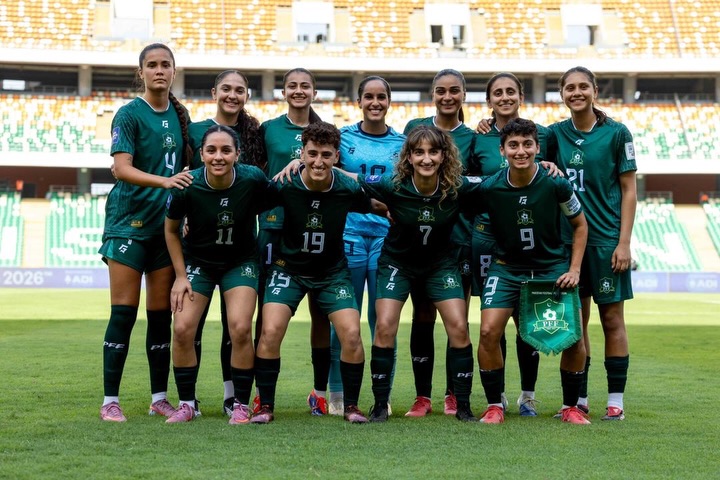
For years, women’s football in Pakistan was caught in a frustrating cycle. There was talent, there were passionate players and there were people willing to work, but opportunities to play and develop were far too limited.
That picture is beginning to change.
The Pakistan Football Federation has now unveiled its Pakistan Women’s Football Strategy 2026-2030, a five-pillar plan designed to create a pathway from grassroots football to the national team. The strategy focuses on participation and competition, player development, education, promotion and inclusion, and governance.
On paper, it is an ambitious plan. But importantly, it comes at a time when there is already evidence that Pakistan’s women’s game can move forward when players are given regular opportunities, better preparation and a clear international platform.
The challenge now is to turn that progress into a structure that can survive for years.
From a return to international football to record wins
The progress of the women’s national team in recent years provides an important backdrop to the new strategy.
Pakistan returned to international football in 2022 after a long absence and immediately produced one of the most memorable results in its history, beating the Maldives 7-0 at the SAFF Women’s Championship.
That result was more than just a big scoreline. It showed what had been missing during years of inactivity: competitive football and a generation of players hungry for international experience.
Since then, Pakistan have continued to collect important results.
In January 2023, the team defeated Comoros 1-0 in Saudi Arabia. Later that year, Pakistan recorded a historic victory over Tajikistan in the Olympic qualifying tournament, while also earning draws against Saudi Arabia and Malaysia in subsequent international competitions.
The biggest signs of progress came in 2025.
Pakistan defeated Indonesia 2-0 and Kyrgyzstan 2-1 in the AFC Women’s Asian Cup qualifiers. Those were particularly significant results because they came against teams from established footballing nations and showed that Pakistan could compete beyond the traditional South Asian environment.
Then came another landmark moment in April 2026.
Pakistan entered the FIFA Series for the first time and announced themselves in spectacular fashion, defeating Turks and Caicos Islands 8-0 at Stade Alassane Ouattara in Abidjan.
The result surpassed the team’s previous biggest victory, the 7-0 win against Maldives in 2022. Four different players scored in the first half alone, underlining the depth and attacking confidence within the side.
For a team that spent years struggling simply to get international fixtures, these results represent a remarkable change in trajectory.
Adeel Rizki has been part of that transformation
Any discussion about the national team’s recent development also has to acknowledge the role of Adeel Rizki.
Rizki took charge of the women’s national team in 2022, immediately before Pakistan’s return to international competition. Since then, he has overseen a period in which the team has gradually gained more international exposure and produced several notable results.
The 8-0 victory over Turks and Caicos was another example. Pakistan played with attacking intent, scored eight goals and kept a clean sheet in a performance that demonstrated both technical confidence and tactical organisation. The AFC described the display as a comprehensive victory as Pakistan made a spectacular start to their FIFA Series campaign.
But perhaps more important than any individual result is Rizki’s continued emphasis on development.
When the new PFF strategy was presented, Rizki highlighted youth football as one of the areas that will determine whether the plan succeeds. His message is important because Pakistan cannot build a competitive senior women’s team simply by assembling a national squad every few years.
The players of tomorrow need to start developing today.
Rizki has also now moved into a broader role within the federation. In July 2026, he became PFF Technical Director, with responsibilities including establishing a technical vision, strengthening coach education and creating player development pathways across the game.
That could make his influence on women’s football even more significant, particularly if the federation succeeds in connecting grassroots programmes, youth teams, clubs and the senior national side.
The next step is bigger than the national team
This is where the new strategy becomes particularly important.
The PFF says Pakistan currently has 62 registered women’s clubs and academies, 673 registered female players and only five certified female referees. Its 2026-30 plan aims to dramatically expand those numbers while creating competitions at national, provincial and district levels.
The federation also wants to establish regional training centres, national youth team programmes and a national talent identification system.
Perhaps the most important target is the plan to give the senior women’s national team at least 10 international matches every year.
That matters enormously.
A national team cannot improve by playing a handful of competitive matches and then disappearing for months. Players need consistent exposure to different styles, levels of intensity and tactical approaches. Coaches need time to build systems. Young players need opportunities to break into the squad.
Regular football creates all three.
The federation also plans to train at least 250 women coaches and increase the number of registered female referees to 100. It wants programmes in schools, colleges and universities to reach at least 2,000 girls annually.
These targets may sound administrative, but they are actually central to the future of the national team.
A stronger national team begins with a much larger football ecosystem beneath it.
The opportunity is bigger than a few big wins
It would be easy to look at the 8-0 victory over Turks and Caicos, the 7-0 win over Maldives or the victories over Indonesia and Kyrgyzstan and conclude that Pakistan’s women’s football has finally turned a corner.
The reality is more complicated.
There have also been difficult results. Pakistan suffered heavy defeats against stronger opposition, including an 8-0 loss to Chinese Taipei in the 2026 Asian Cup qualifiers and defeats against India and other established teams.
That is normal for a team still rebuilding its football structure.
The important point is that Pakistan are now getting the opportunity to learn from those matches.
The real measure of progress will not be whether the national team wins every game. It will be whether the gap between Pakistan and stronger opponents continues to shrink, whether more players emerge from domestic football and whether international performances become increasingly consistent.
That is why the new strategy matters.
From promising moments to a football culture
Pakistan’s women’s football does not need another short-lived burst of attention.
It needs continuity.
The country has already shown that there is talent. Players such as Nadia Khan, Maria Khan, Mariam Mahmood, Layla Banaras and a growing group of young footballers have demonstrated that Pakistani women can compete internationally when given the opportunity.
The next generation should not have to wait years for that opportunity.
The new PFF strategy has the potential to change that by creating a pathway where a young girl can start playing football at school or a local academy, enter organised competitions, be identified through regional structures, progress into youth national teams and eventually compete for the senior national side.
That is the bigger story behind the strategy.
The 8-0 victory in Abidjan was spectacular. The 7-0 win over Maldives remains an important landmark. The victories over Indonesia and Kyrgyzstan showed growing competitiveness.
But those results should be viewed as proof of potential, not the final destination.
Pakistan’s women’s football has finally generated some momentum. Now the task is to build the system that keeps it moving.
If the federation can deliver on its promises, the next five years could be about much more than occasional historic victories.
They could be about making women’s football a permanent part of Pakistan’s sporting landscape.
By: Mohsin Rasheed in Islamabad. Sep 15, 2026

Mohsin is a co-founder & Chief Editor of footballer.pk